The Gut Punch: August 1981 and the Long Fall of America's Unions and Middle Class
“The labor movement did not diminish the strength of the nation but enlarged it by raising the living standards of millions.” — Martin Luther King Jr., AFL-CIO Convention, 1961
“The labor movement did not diminish the strength of the nation but enlarged it by raising the living standards of millions.”
— Martin Luther King Jr., AFL-CIO Convention, 1961
Some dates in history arrive with bands playing and cameras rolling. Others don't look like much until years later, when you turn around and realize that's about where the road took a hard turn. August 1981 was one of those.
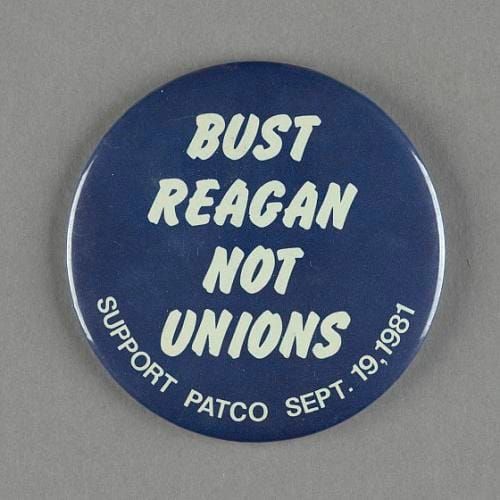
On August 3, nearly 13,000 American air traffic controllers walked off their jobs. Members of the Professional Air Traffic Controllers Organization, better known as PATCO, had complained about long hours, mandatory overtime, understaffing and the enormous stress of a job where one mistake could put hundreds of lives in danger. There was one mighty big hitch, though. Federal employees were prohibited by law from striking.
President Ronald Reagan gave the controllers 48 hours to return. Most refused, and on August 5 he fired 11,345 of them. PATCO was later decertified. Organized labor had just taken a gut punch, and the shock traveled a long way from those airport control towers.
To understand why 1981 matters, back up a few decades. Around 1900, only about 7 percent of American workers belonged to unions, and the broad middle class we later came to recognize was small and still taking shape. Over the next half-century, both grew.
Union membership climbed to more than 30 percent during the great postwar expansion. By 1971, when we have a reliable modern measure of middle-income households, 61 percent of Americans were living in the middle class. Unions didn't build all that by themselves. Anybody telling the history that way is putting too much syrup on the pancakes. America came out of World War II an industrial powerhouse. The GI Bill helped veterans attend college and buy homes, manufacturing boomed and productivity soared.
But unions helped answer one mighty important question: Who gets the money?
Organized workers could bargain for their share of growing prosperity through better wages, pensions, health insurance, paid vacations and safer workplaces. Even workers who never carried a union card could benefit when employers raised wages and benefits to compete for labor or keep their own workers from organizing. The rising tide didn't just lift the yachts. It lifted a few johnboats too.
More important, millions of blue-collar workers didn't have to become white-collar workers to become middle class. A coal miner, steelworker, autoworker, electrician or machinist could make a middle-class living with his hands. Around Appalachia, folks understood that without anybody needing to draw them a chart. A union paycheck could mean a mortgage instead of rent. Health insurance could mean taking a sick child to the doctor without wondering which bill wouldn't get paid. A pension meant an old miner might retire with something besides a worn-out back and a handshake.
Then the direction began to change. Union membership had already fallen from around 30 percent in 1960 to roughly 22 percent by 1980. Manufacturing jobs were disappearing, factories were moving, automation was changing workplaces and foreign competition was growing. Organized labor was already losing ground when August 1981 came along.
When Reagan fired 11,345 air traffic controllers, employers were watching. The President of the United States had confronted a union, fired thousands of its members and won. There's a twist in the story that sounds like something a novelist would've made up: PATCO had endorsed Reagan for president in 1980. Reagan himself had once been president of the Screen Actors Guild and had written PATCO's president during the campaign saying he understood the controllers' concerns.
Less than a year after taking office, he broke their union. Reckon that didn't go quite like PATCO expected.
The firing didn't mean every company could suddenly fire every union worker. Labor law doesn't work that way. What changed was harder to put into a statute book. The political weather had shifted, and taking a hard line against organized labor didn't seem to carry the price it once had.
Union membership kept falling. By 1990, about 16 percent of American workers belonged to unions. By 2000 it was 13.4 percent, and by 2025 just 10 percent did. America had gone from roughly one worker in three during the height of postwar prosperity to one in ten.
While unions were taking a lick, so was the middle class. In 1971, 61 percent of Americans lived in middle-income households. By 2023, that had fallen to 49 percent. Not everybody who left the middle moved downward. Some moved into the upper-income group, but the bigger gut punch may be what happened to the money.
According to Pew Research Center, middle-income households received about 62 percent of total U.S. household income in 1970. By 2022, their share had fallen to 43 percent. Upper-income households went the other direction, increasing their share from about 29 percent to 48 percent. You don't have to be an economist to look at those numbers and figure out something changed.
Now, correlation ain't causation. Every farmer knows rain makes corn grow, but that doesn't mean every cloud deserves credit for the crop. Globalization, automation, disappearing manufacturing jobs, changes in tax policy, healthcare, housing and education costs all played a part in squeezing America's middle class.
Still, ignoring the collapse of organized labor means walking around a pretty good-sized elephant standing in the break room. Unions gave ordinary workers bargaining power, and there's no great mystery to how that works. One fellow sitting across the table from a billion-dollar corporation has a suggestion. Put ten thousand workers behind him and he's got a bargaining position.
That's why August 1981 deserves remembering. PATCO wasn't the day America's unions began declining, and it wasn't the day the middle class started shrinking. History ain't that tidy. But it was a gut punch, one that came at a time when organized labor was already on its heels.
For generations, unions helped turn dangerous jobs into careers, wages into mortgages and paychecks into college educations. They helped somebody wearing work boots and carrying a lunch bucket earn a middle-class living without needing a corner office. Unions didn't build America's middle class by themselves, but they damn sure helped.
Maybe that's the question worth carrying away from August 1981. Instead of only asking what happened to America's middle class, maybe we ought to ask what happened to the bargaining power that helped working people get there.
#WorkBootsBuiltAmerica not Billionaires or Wall Street!
Follow-Up Reading
Reagan Presidential Library — Air Traffic Controllers Strike
https://www.reaganlibrary.gov/archives/speech/remarks-and-question-and-answer-session-reporters-air-traffic-controllers-strike
Smithsonian National Air and Space Museum — PATCO
https://www.si.edu/object/mug-patco%3Anasm_A20070070000
Georgetown University — The 1981 PATCO Strike
https://lhrp.georgetown.edu/collections/the-1981-patco-strike/
Congressional Research Service — Union Membership Trends in the United States
https://www.congress.gov/crs-product/R47596
Pew Research Center — The State of the American Middle Class
https://www.pewresearch.org/2024/05/31/the-state-of-the-american-middle-class/
U.S. Department of the Treasury — Labor Unions and the U.S. Economy
https://home.treasury.gov/news/featured-stories/labor-unions-and-the-us-economy

John W. Peace II is a syndicated feature writer, two-time Amazon bestselling author and fifth-generation Virginia farmer whose work focuses on rural America, Appalachian culture, history and the people who keep small-town America running. Learn more at www.JohnWPeace.com and visit https://pickup-trucks-progress.ghost.io/ & www.BackPorchTalesAndTravels.com for more stories from across Appalachia and rural America.
Readers, please share. Newspapers and magazines wishing to republish this or another article, please just email me. urtopix1@gmail.com
Comments ()