
Imagine This Headline: "New Jersey’s Governor Declares a State of Emergency Over Maternity Care Crisis!"
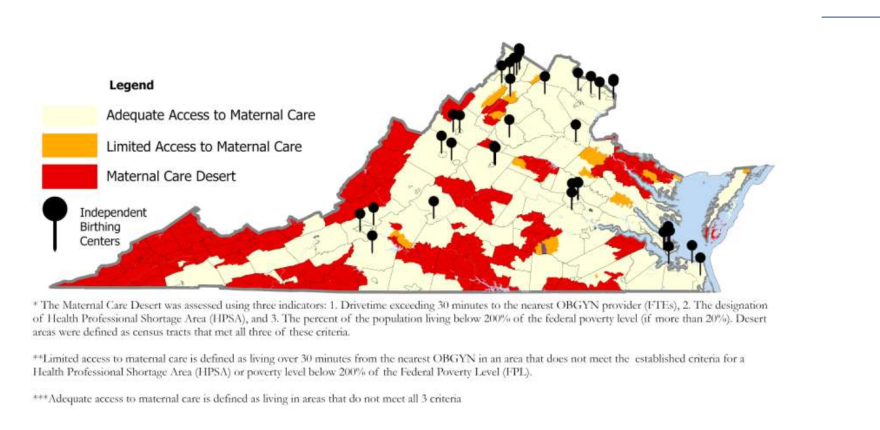
According to the Virginia Department of Health, a maternity care desert is an area where families live more than thirty minutes from obstetrical care, healthcare providers are already in short supply, and poverty makes access even harder.
The story you're about to read isn't about New Jersey. It's about Virginia.
Tomorrow morning is going to start like most mornings. You'll stumble into the bathroom, wander into the kitchen, and reach for the coffee pot before you're fully awake. You'll pour a little creamer into the cup and watch that little mushroom cloud swirl around like it's putting on a show just for you. Then you'll take that first sip that reminds you life may not be so bad after all.
About then you'll pick up the TV remote. The morning news comes on.
The anchor looks into the camera and says, "Breaking News. New Jersey’s Governor has declared a State of Emergency after another maternity ward closed, forcing expectant mothers to travel into neighboring states to deliver their babies. Legislative leaders have called a Special Session. Republicans and Democrats are introducing emergency legislation to protect mothers and newborns. Doctors warn that babies are at risk if action isn't taken immediately."
For the next month, the story dominates the news. Editorial writers demand answers. Politicians race to microphones. Nobody wants to explain how one of America's wealthiest states can't provide safe maternity care.
Now close your eyes for a moment.
Replace the words "New Jersey" with "Southwest and Southside Virginia."
The story you just imagined isn't happening in New Jersey. It's happening here, in Virginia.
The researchers now identify Virginia's maternity care deserts cover roughly the same amount of land as the entire state of New Jersey. The difference isn't the size of the crisis. The difference is the response.
In our imaginary New Jersey story, government moves like the building's on fire. Here in Virginia, researchers have spent years studying the problem, publishing reports, creating task forces, and even giving it a name.
Maternity Care Desert.
You don't invent a term like that because somebody was having a boring day. You invent it because a healthcare problem has become so widespread that researchers need a name for it.
According to the Virginia Department of Health, a maternity care desert is an area where families live more than thirty minutes from obstetrical care, healthcare providers are already in short supply, and poverty makes access even harder. Those three factors combine to create some of the highest-risk areas for expectant mothers and newborns.
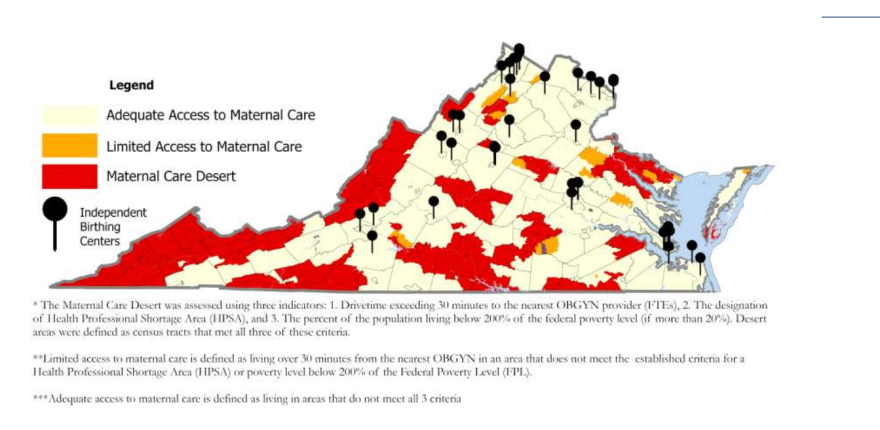
The map tells the story better than words ever could. Large portions of Southwest and Southside Virginia are shaded red, forming a maternity care desert that stretches across an area roughly the size of New Jersey. If an entire state lost reliable maternity care, it would become a national story. Yet because it's happening across rural Virginia, it barely causes a ripple outside the communities living through it.
For expectant mothers, this isn't an abstract policy debate. It means driving an hour or more for prenatal appointments, navigating mountain roads in winter, spending more on gasoline, taking additional time off work, and hoping labor doesn't begin before reaching the hospital.
A recent WVTF/Radio IQ story followed Big Stone Gap resident Mekesha Cody through her high-risk pregnancy. Because specialized care wasn't available close to home, she regularly traveled to Johnson City TN for treatment. Her story reflects the reality facing many families across Southwest Virginia.
Dr. Robert Saunders, an obstetrician at Norton Community Hospital, summed up the situation with remarkable simplicity.
"Without it there's a huge gap. And you may not know what you're gonna lose until it's gone."
He wasn't just talking about delivering babies.
When a community loses its maternity ward, it becomes harder to recruit physicians. Young families may decide to live somewhere else. Hospitals lose another critical service, making it even harder to remain financially stable. Economic developers trying to attract employers discover that quality healthcare has become another hurdle.
Hospitals don't close maternity wards because they want to. Rural birth rates have declined. Recruiting obstetricians, nurses, anesthesiologists, and pediatricians has become increasingly difficult. Medicaid reimbursement often fails to cover the cost of obstetrical care, while malpractice insurance remains expensive. Many rural hospitals simply run out of options.
The March of Dimes estimates that more than one-third of America's counties are now maternity care deserts, affecting more than 2.3 million women of childbearing age. Research consistently links longer travel times with delayed prenatal care, higher rates of premature birth, and increased health risks for both mothers and infants.
Southwest Virginia faces additional challenges. Long mountain drives, severe winter weather, flooding, and limited transportation can turn a routine trip to the hospital into a dangerous race against time. According to the WVTF reporting, in SWVA, some families are traveling nearly two hundred miles for maternity care.
Virginia doesn't have an information problem. The Virginia Department of Health has issued reports. The General Assembly has formed task forces. Researchers have documented the risks. Healthcare professionals have testified. Journalists have told the stories.
The diagnosis has already been made. The question is whether Virginia has the political WILL to treat the patient.
Every Virginian entered this world because somewhere there was a doctor, nurse, or midwife ready to help. Healthy mothers and healthy babies shouldn't be a Republican issue or a Democratic issue. They should be a Virginia issue.
If this crisis were unfolding across New Jersey, state and federal politicians would likely be falling over one another to announce solutions.
Southwest, Southside and other rural areas of Virginia deserve that same sense of urgency.
Because our babies deserve BETTER!
For More Reading
Virginia Department of Health Maternal Deserts Task Force Report https://www.vdh.virginia.gov/content/uploads/sites/233/Maternal-Deserts-Task-Force-9.24.2025-TF.pdf
Virginia General Assembly Maternal Health Data and Access Report https://rga.lis.virginia.gov/Published/2026/RD147/PDF
WVTF / Radio IQ In Rural Southwest Virginia, Some Women Travel Over an Hour to Give Birth https://www.wvtf.org/news/2026-07-02/in-rural-southwest-virginia-some-women-travel-over-an-hour-to-give-birth
March of Dimes Nowhere to Go: Maternity Care Deserts Across the United States https://www.marchofdimes.org/maternity-care-deserts-report-2022
John W Peace II





Comments ()