From Justified to The X-Files: Why Snake Handlers Keep Showing Up in Hollywood
From Justified to The X-Files: Why Snake Handlers Keep Showing Up in Hollywood
Whenever I speak to a civic club, library group, or book club about one of my books, I tell folks I'm from Big Stone Gap, Virginia. Somebody almost always asks where that is, and I grin and tell them, "Big Stone Gap is so far back in the mountains, even the Presbyterian churches handle snakes."
That usually gets a laugh. Then somebody asks, "Wait a minute. Do snake handling churches really exist?" The follow-up comes just as quickly.
"Have you ever been to one?"
The answer to both questions is “Yes!”
I was seventeen years old when I attended my first snake handling. The reason this young Presbyterian boy, who had dutifully gone through confirmation class and could recite the Apostles' Creed by heart, found himself sitting on the front pew of a serpent handling church was simple enough: a very pretty mountain girl invited me.
Looking back, I suppose I was lucky she didn't drive a panel van, or I might not be here writing this story.
There I sat, trying to look calm and collected. A little speaking in tongues started up around me, but that didn't bother me much; I'd visited other Pentecostal churches before. Then the preacher dragged out a big wooden trunk with shiny brass latches. I figured, maybe that's where they kept the hymnals.
I was wrong.
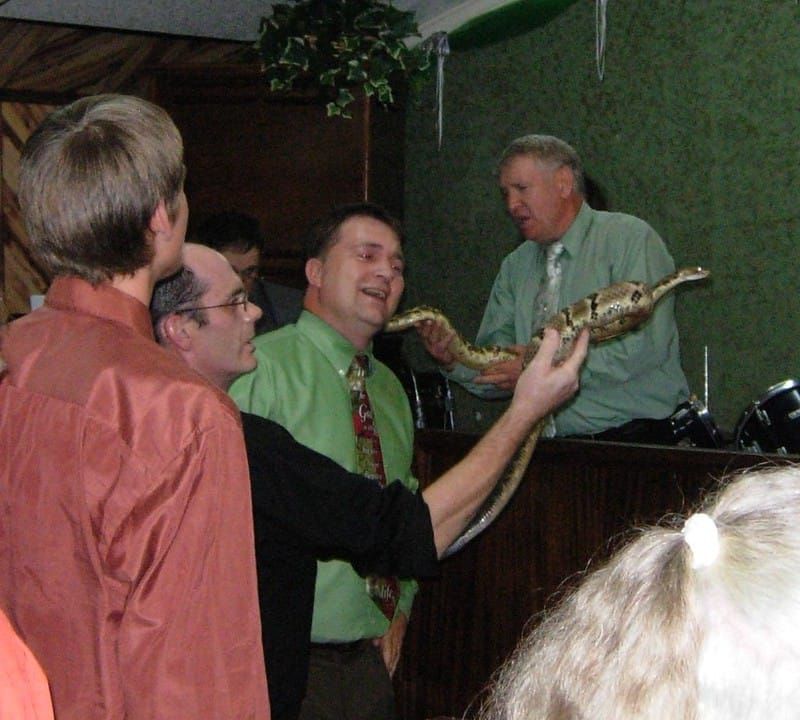
He flipped open the lid, reached in with both hands, and came out holding two armfuls of snakes. Then he started down the aisle, so every adult in the church could reach out and grab a serpent as if they were passing around biscuits at a church supper.
The pretty girl who invited me picked one up without a hint of fear, and then glanced over at me expectantly. I was on the spot.
I'm no snake expert, but I knew enough to tell the difference between a rattlesnake and a black snake. So when it was my turn, I grabbed hold of a harmless black snake and figured that if my faith happened to falter that evening, I'd at least live long enough to see Monday morning.
Most Americans have never set foot inside a snake handling church, but they sure think they know one when they see it on television.
Hollywood can't seem to leave snake handlers alone.
The television series Justified in season four featured a traveling snake-handling revival church in Harlan County, Kentucky. The X-Files built one of its eeriest episodes around a serpent-handling congregation in Tennessee. The movie Them That Follow centered its entire story on a snake-handling church in Appalachia, and the reality series Snake Salvation followed Kentucky pastor Jamie Coots and Tennessee preacher Andrew Hamblin, bringing the practice into living rooms all across America.
In movie and television land, snake handlers are usually portrayed as mysterious, dangerous, and maybe just a little crazy. They become shorthand for an exotic Appalachia, a place where old superstitions linger and strange things happen in little churches tucked back in the hills.
The truth, as usual, is a lot more complicated.
Snake handling churches are part of a much larger tradition of Appalachian Pentecostalism. Speaking in tongues, divine healing, shouting, and old-fashioned revival meetings have been woven into mountain life for generations. Most Pentecostal churches never handled snakes, and most mountain churches certainly didn't. A small group of believers, however, took one passage of Scripture very seriously.
"They shall take up serpents."
To them, those words in the Gospel of Mark weren't symbolic. They were instructions.
Most historians trace the modern movement to George Went Hensley, a preacher born in Scott County, Virginia, and raised in East Tennessee. Around 1910, Hensley began incorporating live rattlesnakes into worship services and spent years traveling through Appalachia preaching what became known as the "signs following" message.
Some accounts even place his early experiences around Big Stone Gap and in the coal camps of Southwest Virginia, which means my own backyard may have played a role in the birth of one of America's most unusual religious traditions!
The practice eventually spread across East Tennessee, Southeastern Kentucky, Southwest Virginia, West Virginia, and parts of Alabama and Georgia. Mainline Pentecostal denominations rejected serpent handling, and many of the congregations became independent churches. States passed laws against handling venomous snakes during worship, and there have been deaths over the years, including Hensley himself, who died in 1955 after suffering a rattlesnake bite during a church service in Florida.
Despite the regulation against it, these churches endured because, for the people inside them, this was never about putting on a show.
It was about faith.
The same mountains that produced coal miners willing to crawl a mile underground and farmers willing to bet a year's work on the weather also produced believers willing to place their lives in God's hands in a very literal way. You don't have to agree with them to understand that kind of conviction.
Maybe that's why Hollywood keeps coming back to pious serpent wranglers. They represent something that fascinates Americans: people who believe something so deeply that they're willing to risk everything for it.
The problem is that the movies often stop there.
They rarely tell the rest of the story.
The real story isn't actually about snakes at all. It's about Appalachia, a region that has long been treated as America's mystery land, a place outsiders think they understand because they've seen a television show, watched a documentary, or heard an old joke about mountain people.
The snake handlers are real. I've sat in their churches and held one of their snakes. They're also our neighbors, our cousins, and, in my case, the pretty mountain girl who invited a nervous seventeen-year-old Presbyterian boy to church one Sunday evening.
And yes, I lived to see Monday morning.
Do Your Own Research
- FX's Justified
- The X-Files episode "Signs and Wonders"
- The film Them That Follow
- Salvation on Sand Mountain by Dennis Covington
- Christian History Institute – They Shall Take Up Serpents
- The documentary Holy Ghost People
- The Association of Religion Data Archives
From King Coal and the Coal Wars to Woodboogers, Granny Witches, Hillbilly Hoo-Doo, Melungeons, moonshine legends, and mountain folklore, the mountains around Big Stone Gap VA have inspired storytellers for generations.
No wonder this region helped inspire bestselling novels like The Trail of the Lonesome Pine, Adriana Trigiani’s Big Stone Gap books and upcoming television series, and just over the mountain in Harlan, Kentucky, the world of Justified. Experience more Big Stone Gap stories with A Boy From Crackers Neck, The Keokee Triangle and the upcoming Ghosts of the Moonshine Mafia.
Welcome to:
“The Big Stone Gap Storyverse in Appalachia”
Where the mountains still remember.
Comments ()