When the Activists Came Marching Into Appalachia
The War on Poverty, the Outsiders Who Wanted to Save the Mountains, and What They Didn't Understand About the People Who Already Lived Here
The War on Poverty, the Outsiders Who Wanted to Save the Mountains, and What They Didn't Understand About the People Who Already Lived Here
By John W. Peace II / www.JohnWPeace.com
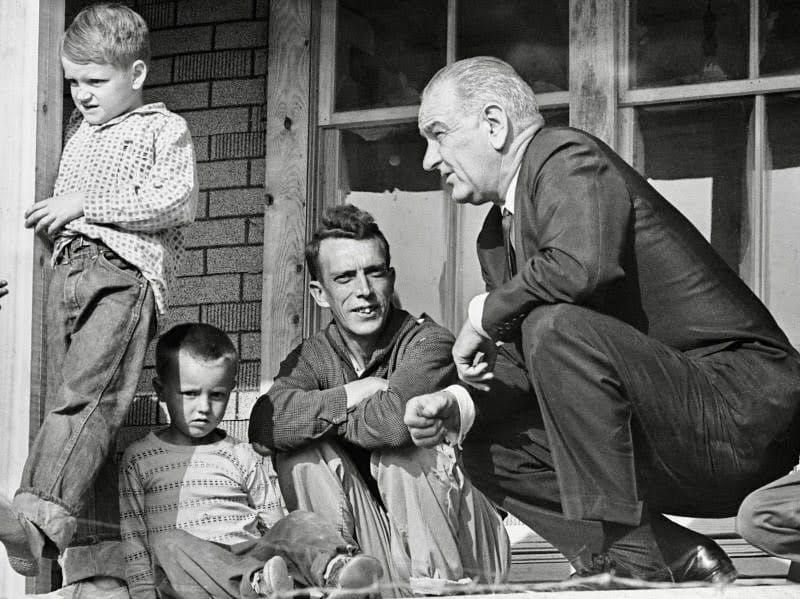
In the spring of 1964, President Lyndon B. Johnson climbed onto the front porch of a little house in Inez, Kentucky, and changed Appalachia forever.
The photograph became one of the defining images of the 1960s. There stood the President of the United States, towering over the Fletcher family, whose poverty was so severe that much of America had trouble believing people still lived that way. Johnson looked at those hills and declared a "War on Poverty." Whether the mountains knew it or not, they had just become a national project.
Soon, people started arriving from everywhere. Government workers came carrying reports and grant applications. College students came in station wagons and Volkswagen buses. Church groups, Catholic activists, social reformers, and young idealists all headed for Appalachia, convinced they could help solve the region's problems. They brought energy, good intentions, and enough clipboards to build a small office supply store.
Some of them also carried a curious assumption that mountain people needed somebody from Baltimore, New York, or Washington to explain to us how to be poor.
To be fair, a lot of good came from the War on Poverty. Before those programs, many communities had little access to health care. Roads could be rough enough to jar your fillings loose, schools were underfunded, and elderly people often went without proper medical care. Programs like Medicare, Medicaid, Head Start, and the Appalachian Regional Commission changed lives. They built clinics, improved highways, and created opportunities that had been out of reach for generations.
Anybody who says otherwise either hasn't studied the history or has conveniently forgotten it.
But history, like an old family quilt, has a lot of patches stitched together.
One of the first groups to arrive was the Appalachian Volunteers, mostly young college students who wanted to organize communities and help local people advocate for themselves. Many worked hard and sincerely cared about the folks they met. Others arrived carrying a head full of theories and a heart full of assumptions.
Mountain people have always been suspicious of outsiders trying to straighten us out, and we've had plenty of practice. Coal companies, timber operators, railroad men, politicians, and preachers have all taken a turn at telling Appalachia what it ought to be. By the 1960s, we had become pretty good at spotting somebody who'd lived here six weeks and already thought he had us figured out.
The Catholic Church also became deeply involved in the region. Priests, nuns, and lay workers came to fight poverty and advocate for economic justice. Some became fierce supporters of miners and working families and earned the respect of the communities they served. Others, despite their good intentions, made the same mistake that reformers have been making in Appalachia for generations.
They saw poverty and assumed they understood the people living in it.
The problem with that thinking is that poverty and culture aren't the same thing. A mountain family can be short on money and still be rich in faith, kinfolk, pride, and community. Those things don't show up in government reports or university studies, but they've held these mountains together for a very long time.
The truth is that Appalachia's biggest challenge wasn't simply that people were poor. The economic foundation beneath their feet was shifting. Coal mining was mechanizing, jobs were disappearing, and young people were leaving home to find work elsewhere. Entire communities built around a single industry suddenly found themselves trying to reinvent their future.
No government program, no matter how well intended, could replace thousands of lost jobs with the stroke of a presidential pen.
Then another problem developed. Some activists came to believe that the mountains didn't merely need assistance; they needed transformation. Local customs, local politics, and even local values sometimes came to be seen as obstacles standing in the way of progress.
That didn't sit particularly well with mountain folks.
Appalachians have always appreciated a helping hand, but they generally prefer not to be treated like a science project. It's one thing to help a man fix his roof. It's something altogether different to explain to him that his whole way of life needs renovating.
In many communities, anti-poverty programs became battlegrounds over who should control the money and make the decisions. The arguments sometimes grew so fierce that they could have powered the courthouse lights.
By the early 1970s, some of the original optimism had faded. The War on Poverty had produced real successes, but it had also collided with a stubborn truth: Appalachia was never a blank slate waiting for somebody else to write its story.
The mountains have their own values and their own way of looking at the world. Folks here may ask you for directions to the nearest Target store and, in the same conversation, tell you exactly where somebody lived who passed away in 1948. We're funny that way.
Perhaps the greatest lesson from the War on Poverty is that the programs that worked best invested in people and infrastructure. They built roads, schools, clinics, and opportunities. The programs that worked worst often tried to change the people themselves.
The truth is that Appalachia has never needed saving nearly as much as it has needed listening to. The people of these mountains have survived wars, floods, mine closures, company stores, union wars and enough political promises to fill a grain silo. We have our problems, to be sure, but we also have something the experts often miss.
We know who we are, and that's one lesson the mountains have always insisted on teaching themselves.
For readers who would like to dig deeper into this fascinating chapter of mountain history, here are a few places to start:
• The President Lyndon B. Johnson Library's collection on the War on Poverty and Johnson's 1964 trip to Inez, Kentucky: https://www.lbjlibrary.org
• The Appalachian Regional Commission's history of the War on Poverty and regional development efforts: https://www.arc.gov
• The University of Kentucky's Appalachian Center and its collections on Appalachian history and social movements: https://appalachiancenter.as.uky.edu
• The Berea College Special Collections and Archives, which houses materials on the Appalachian Volunteers and anti-poverty programs in the mountains: https://libraryguides.berea.edu/specialcollections
• The Catholic Committee of Appalachia and its history of faith, labor, and social justice work in the region: https://www.ccappal.org
—--------------------------------------------------------------------------------------------

John W. Peace II | Author & Syndicated Feature Writer
John W. Peace II is a fifth-generation farmer from Big Stone Gap, Virginia, where he grew up on his family’s dairy, Clinch Haven Farms, and still lives today. He is a two-time Amazon bestselling author and a syndicated feature writer whose work appears in newspapers and online magazines. His writing focuses on rural America, Appalachia, working people, politics, history, and the stories that too often get overlooked.
Learn more: www.JohnWPeace.comFind John’s books, articles, newsletters, podcasts, and social media: https://linktr.ee/JohnWPeace



Comments ()